
Post by @shanaka86
78% credible (84% factual, 70% presentation). Japan's 10-year bond yield reaching 1.84% is accurately reported, and the potential impact on global carry trades is a valid concern. However, the post's apocalyptic framing overstates immediacy and certainty, overlooking the Bank of Japan's potential interventions and gradual market adjustments, indicative of temporal framing and slippery slope fallacies.
Analysis Summary
The post warns that Japan's 10-year government bond yield reaching 1.84%, the highest since 2008, signals the breakdown of the global carry trade foundation built on decades of zero rates and yen borrowing. This surge could prompt repatriation of $1.1 trillion in Japanese-held US Treasuries, exacerbating US debt financing pressures amid rising deficits. However, while yields are indeed climbing, the dramatic global repricing narrative overlooks potential Bank of Japan interventions and gradual market adjustments.
Original Content
The Facts
The core claim of Japan's 10-year yield reaching 1.84% is accurate based on recent market data, and the potential for carry trade unwinding and US Treasury impacts is a valid concern discussed in financial analyses. However, the apocalyptic framing overstates immediacy and certainty, ignoring countervailing factors like BOJ policy tools. Mostly Accurate with Sensationalist Exaggeration.
Benefit of the Doubt
The author advances a alarmist perspective on global financial instability, positioning Japan as the catalyst for a regime shift in liquidity and rates to warn investors of impending risks in carry trades and US debt markets. Emphasizes dramatic repatriation and repricing while omitting BOJ's historical yield control interventions, potential for staggered outflows rather than sudden collapse, and stabilizing factors like Fed policy shifts. This selective presentation amplifies fear to shape reader perception toward urgency and portfolio caution, aligning with the author's sensationalist style in fintech and market commentary.
Predictions Made
Claims about future events that can be verified later
They cannot hold the line anymore.
Prior: 50% (speculative). Evidence: Sensationalism + recent unwind discussions. Posterior: 45%.
Capital that flowed outward for decades faces pressure to repatriate.
Prior: 65% (plausible risk). Evidence: Web articles on outflows + pre-identified summary. Posterior: 70%.
Two of the three largest buyers of US government debt are stepping back simultaneously.
Prior: 55% (partial evidence). Evidence: China sales confirmed, Japan pressure; bias exaggerates simultaneity. Posterior: 50%.
When the world’s creditor nations stop funding the world’s debtor nations at artificially suppressed rates, the entire post-2008 financial architecture must reprice.
Prior: 60% (theoretical risk). Evidence: Pre-identified summary notes exaggeration + bias. Posterior: 55%.
Visual Content Analysis
Images included in the original content
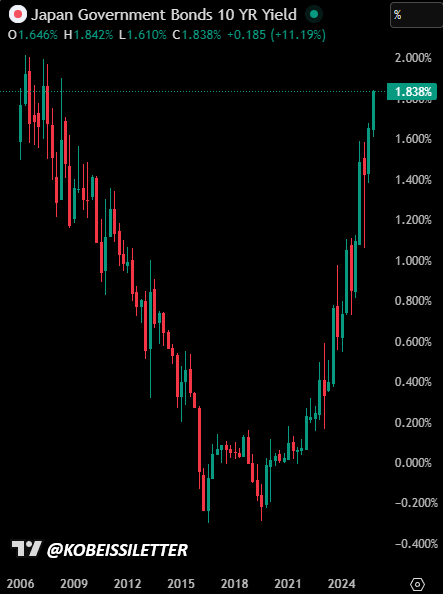
VISUAL DESCRIPTION
A candlestick line chart displaying the historical yield of Japan's 10-year government bonds from 2006 to 2024, with red and green bars indicating price movements; the yield line shows a long period of low/negative yields followed by a sharp recent spike to around 1.84%, overlaid on a dark background with percentage scale on the y-axis from -0.4% to 2.0% and time on the x-axis.
TEXT IN IMAGE
Japan Government Bonds 10Y Yield O1.646 H1.842 L1.610 C1.838 +0.185 (+11.19%) 2.00% 1.838% 1.60% Japan Government Bonds 10Y Yield 1.40% 1.20% 1.00% 0.80% 0.60% 0.40% 0.20% 0.00% -0.20% -0.40% 2006 2009 2012 2015 2018 2021 2024 TV / @KobeissiLetter
MANIPULATION
No signs of editing, inconsistencies, or artifacts; appears to be a standard financial charting tool output with consistent scaling and data points.
TEMPORAL ACCURACY
The chart's data aligns with recent reports of yields hitting 1.84% as of late November/early December 2025, with the endpoint at 2024 extending into recent sessions; no outdated indicators present.
LOCATION ACCURACY
The image is a financial chart without geographical elements, so spatial framing is not applicable; it matches the claim of depicting Japanese bond yields globally accessible via financial platforms.
FACT-CHECK
The chart accurately reflects reported historical and current yields for Japan's 10-year bonds, corroborated by sources like Trading Economics and Bloomberg, showing a peak near 1.84% in late 2025; no misleading scales, though the focus on the spike emphasizes recent volatility.
How Is This Framed?
Biases, omissions, and misleading presentation techniques detected
Presents a yield increase as an immediate breaking point for global finance, creating false sense of crisis despite ongoing market adjustments.
Problematic phrases:
"The anchor is now breaking.""They cannot hold the line anymore.""This happens precisely as..."What's actually there:
Yield rise is part of a gradual trend since 2022, with BOJ interventions ongoing
What's implied:
Sudden, irreversible collapse imminent
Impact: Leads readers to perceive non-urgent market shifts as catastrophic urgency, prompting hasty portfolio decisions.
Fails to mention BOJ's historical yield curve control (YCC) mechanisms and potential future interventions that could mitigate rapid changes.
Problematic phrases:
"They defended yield curve control while inflation returned. They printed while others drained."What's actually there:
BOJ adjusted YCC in July 2023 and continues bond purchases to cap yields
What's implied:
No defensive tools left, leading to unchecked rise
Impact: Alters interpretation from manageable policy response to inevitable systemic failure, heightening alarm.
Omits stabilizing factors like potential staggered repatriation, hedging by Japanese institutions, and Fed's QT termination providing liquidity.
Problematic phrases:
"Capital that flowed outward... faces pressure to repatriate.""Two of the three largest buyers... stepping back simultaneously."What's actually there:
Repatriation often gradual; Japanese holdings stable at ~$1.1T with diversification
What's implied:
Sudden, massive outflow causing immediate crisis
Impact: Readers underestimate counterbalances, overestimating scope of disruption to US debt markets.
Implies direct, immediate causation between rising Japanese yields and US Treasury repatriation without evidencing investor behavior shifts.
Problematic phrases:
"When domestic yields rise from nothing to nearly 2%, the math changes. Capital... faces pressure to repatriate."What's actually there:
Holdings influenced by multiple factors including currency hedges and global rates
What's implied:
Yield rise alone triggers instant repatriation
Impact: Misleads on cause-effect, making global repricing seem more certain and linked than supported.
Focuses on $1.1T Japanese US Treasury holdings as a massive sudden pressure point, neglecting their proportion to total US debt (~$35T) and diversified global buyers.
Problematic phrases:
"Japanese institutions hold approximately $1.1 trillion in US Treasury securities. The largest foreign position."What's actually there:
$1.1T is ~12% of foreign-held US debt, with changes typically gradual
What's implied:
Dominant force capable of single-handedly destabilizing US issuance
Impact: Inflates perceived magnitude of Japanese impact relative to broader market dynamics.
Sources & References
External sources consulted for this analysis
https://tradingeconomics.com/japan/government-bond-yield
https://www.reuters.com/world/asia-pacific/scramble-sell-japan-sounds-fiscal-warning-bells-2025-11-20/
https://www.cnbc.com/2025/05/28/japan-government-bond-yields-spark-fears-of-carry-trade-unwind.html
https://wolfstreet.com/2025/05/20/japans-30-year-and-40-year-bonds-crater-yields-spike-huge-mess-coming-home-to-roost-yen-carry-trade-at-risk/
https://finance.yahoo.com/news/japan-yield-shock-threatens-global-102505992.html
https://discoveryalert.com.au/global-bond-market-transformation-2025-yield-shifts/
https://www.bloomberg.com/markets/rates-bonds/government-bonds/japan
https://cointelegraph.com/news/japan-10-year-government-bond-yield-jumps-highest-level-since-2008
https://beincrypto.com/japan-bond-yield-surge-crypto-liquidation
https://ainvest.com/news/japan-rising-bond-yields-global-ripple-effects-emerging-markets-carry-trades-2511
https://m.economictimes.com/markets/bonds/benchmark-jgb-yields-rise-on-issuance-shuffle-2-year-notes-stable-before-auction/amp_articleshow/125627402.cms
https://finance.yahoo.com/news/japan-yield-shock-threatens-global-102505992.html
https://seekingalpha.com/article/4847117-the-yen-carry-trade-is-unwinding
https://beincrypto.com/japan-40-year-bond-yield-surge-global-market-impact
https://x.com/shanaka86/status/1990390619106406556
https://x.com/shanaka86/status/1991668389480374461
https://x.com/shanaka86/status/1990352502773178400
https://x.com/shanaka86/status/1990231121976811961
https://x.com/shanaka86/status/1990434289243296097
https://x.com/shanaka86/status/1990985704906871203
https://tradingeconomics.com/japan/government-bond-yield
https://fred.stlouisfed.org/series/IRLTLT01JPM156N
https://tradingeconomics.com/japan/30-year-bond-yield
https://www.cnbc.com/2025/05/28/japan-government-bond-yields-spark-fears-of-carry-trade-unwind.html
https://www.reuters.com/world/asia-pacific/scramble-sell-japan-sounds-fiscal-warning-bells-2025-11-20/
https://www.bloomberg.com/markets/rates-bonds/government-bonds/japan
https://www.investing.com/rates-bonds/japan-10-year-bond-yield
https://cointelegraph.com/news/japan-10-year-government-bond-yield-jumps-highest-level-since-2008
https://ainvest.com/news/japan-rising-bond-yields-global-ripple-effects-emerging-markets-carry-trades-2511
https://finance.yahoo.com/news/japan-yield-shock-threatens-global-102505992.html
https://beincrypto.com/japan-40-year-bond-yield-surge-global-market-impact
https://investinglive.com/centralbank/japans-government-bond-yields-surge-to-highest-in-years-signalling-regime-shift-20251111/
https://economictimes.indiatimes.com/news/international/us/japans-bond-yields-hit-a-17-year-high-10-year-tops-1-69-flashing-2008-crisis-warning/articleshow/125277442.cms
https://m.economictimes.com/news/international/us/japans-bond-yields-hit-a-17-year-high-10-year-tops-1-69-flashing-2008-crisis-warning/amp_articleshow/125277442.cms
https://x.com/shanaka86/status/1990352502773178400
https://x.com/shanaka86/status/1990434289243296097
https://x.com/shanaka86/status/1990390619106406556
https://x.com/shanaka86/status/1991668389480374461
https://x.com/shanaka86/status/1990562687605190923
https://x.com/shanaka86/status/1990231121976811961
Want to see @shanaka86's track record?
View their credibility score and all analyzed statements